A dog-friendly venue gives you the option of bringing your dog. Deciding whether to use it takes a closer look at your dog, the setting, and the help available on the day.
Use the questions below to choose between a ceremony role, a short visit, and staying home. You do not have to make an all-day commitment. Once you know which version suits them, the planning and the personal details become easier to choose.
Start with your dog's ordinary behavior
Think about what your dog does when visitors arrive, when a room gets noisy, or when a routine changes. Do they approach, settle, take breaks, or spend most of the visit trying to get away? Your observations at home and in other familiar situations are more useful than a picture of a dog walking down an aisle.
A friendly dog may still prefer a short visit. A dog who is affectionate with you may not enjoy greetings from strangers. You are choosing a plan for this dog, rather than deciding whether they deserve to be included.
“I had been describing Bruno as friendly because he adores our friends. My partner pointed out that he spends the first half of every party behind my chair. That was the detail I kept leaving out of my wedding plans.”
Andre Collins
Check the actual venue and the backup plan
Ask exactly where dogs are permitted, whether they must remain leashed, whether a quiet room is available, and what changes if it rains. Get the answers in writing. An outdoor pet policy may not extend to the indoor ceremony space.
If a visit is possible, notice the route from the parking area, flooring, doors, stairs, shade, and distance to a quiet exit. Ask about the event environment, too: music, food service, crowd size, and how long your dog would need to be there. Permission is only the first part of the decision.
Match the role to what they can comfortably do
An aisle walk, a portrait visit, and a reception appearance ask different things of a dog. Choose the shortest version that gives you the moment you want. Rehearse only what is useful, keep the handler close, and have a plan that does not depend on a perfect response to a cue.
If a dog is recovering, uncomfortable, or struggling with unfamiliar environments, discuss the specific plan with your vet or a qualified behavior professional. A wedding is not a useful deadline for overcoming a problem that needs more time.
Give one person responsibility and permission to leave
Your handler should know your dog, have no competing wedding duties during the visit, and understand the route to a quiet space and the trip home. Write down who makes the decision to leave and make sure that person does not need to interrupt your ceremony to act.
Agree on what your dog's discomfort looks like rather than relying on a generic checklist. If they cannot settle or seem unhappy, shortening the visit is a valid outcome. The photographs can wait; the plan should make leaving easy.
If the answer is yes, keep the visit simple
Confirm the handler, transport, arrival window, departure window, and venue contact. Pack familiar equipment, water, waste bags, and the supplies your dog normally uses. Tell guests and catering staff who is caring for the dog so nobody improvises food or handling.
Aim for a plan you could explain on one page. More activities do not automatically make the dog more included, and each additional stop is another transition to manage.
If the answer is no, you still have good options
“We worked through the questions and the answer was obviously no, which was honestly a relief. She would have hated it and we would have spent the whole day worrying about her.”
Isabel Voss
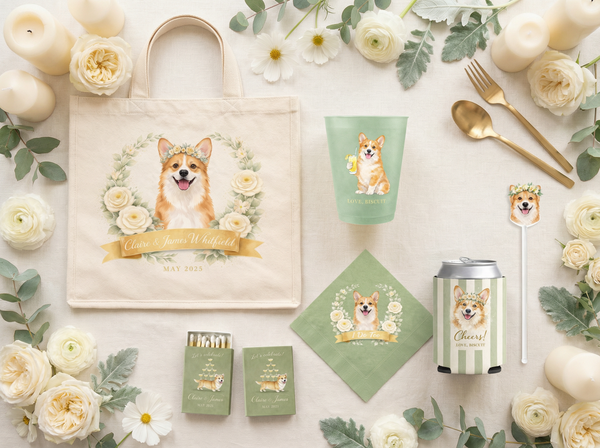
A favorite photograph, a drink named after your dog, or an illustrated detail at the bar lets you recognize their place in your life. You can make the gesture as small or visible as you like while their care happens somewhere comfortable.

If a portrait on a practical detail appeals to you, custom dog cocktail napkins gives you a starting point. Choose the face and wording you would be happy to notice during cocktail hour, then let the rest of the wedding continue around it.
Keep their place in the day
Choosing a day at home does not mean removing your dog from the celebration. A portrait on cocktail napkins can be one small reference to the life you share. Look at the available styles and choose the treatment that feels familiar to you.